
Does India have the infrastructure to support DeepTech innovations? Unlike Consumer businesses, do start-ups building in DeepTech need to have global demand to become a $1 Billion business? Is India ready to rewire itself on utilizing deep technology companies within India - Supply chain, cold storage, biotech etc?
India’s tech ecosystem is waking up from the food-delivery craze of the 2010s. Actual science and hardcore engineering - AI, quantum, biotech, materials, and more - are taking center stage. DeepTech startups are solving problems no one even knew were worth solving before.
With emerging government policy, easier access to capital, and talent finally aligning, India is quietly becoming a global DeepTech powerhouse. And founders, dreaming of building tomorrow’s tech - are indeed reimagining the landscape.
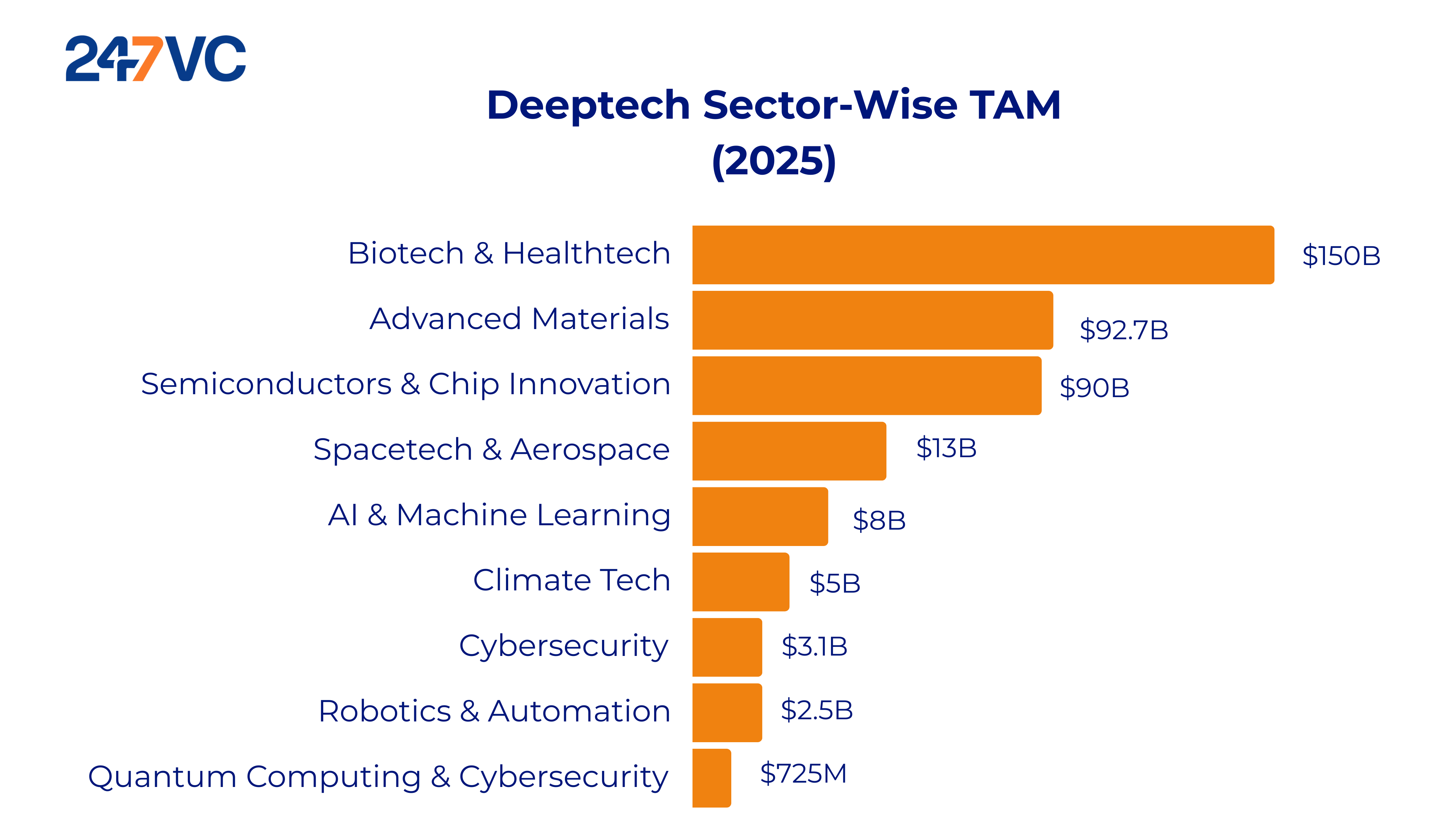
DeepTech in India a data-backed boom:
- 4,000+ deep tech startups are now active in India (there were 3,600 in mid-2024), ranking the country 6th globally (For context, India’s overall startup ecosystem’s rank is 3rd.)
- Funding is surging. Companies raised a total of $1.6 billion in 2024 (a 78% jump over 2023). In early 2025, that pace doubled: $324 million in Jan - Apr alone (vs $156M in the same 2024 period).
- New startups are emerging. In 2024, India saw 480 deep-tech startups launched, twice the number from 2023.
- AI dominates. A whopping 74% of new Deep Tech ventures in 2024-25 focus on AI (think generative models, computer vision, language tech, etc.). Foundational AI for Indian contexts (see Sarvam AI for Indic language models & more factually correct content for Bharat) is a huge unmet need.
- Bigger bets over time. The average Deep Tech seed round in India has grown 5.3× over the last 8 years, outpacing the global average. Investors are finally writing larger cheques and longer-term cheques for scientific breakthroughs.
- Nascent unicorns: While still young, companies like QNu Labs, QpiAI, Ather, IdeaForge drones and Fractal Analytics AI will accelerate the pace of other startups reaching Series A/B as investors see their returns.
.png)
Each stat above is another “aha” for a founder: there is real business model & innovation here. However, the need for evolution has again gained trust for capital-intensive ventures.
India’s ecosystem is building momentum and world-class technical talent is returning home. We’re at a tipping point especially in material science.
.png)
Indian founders have a wide frontier to explore. 247VC research team came up with some of the biggest arena bets and examples of homegrown players (with global peers for context):
1. AI & Intelligent Systems:
Nearly 3 in 4 new Indian DeepTech startups are AI-focused, building everything from generative AI to AI-powered diagnostics. The domestic market for AI and analytics is projected to hit $7.8 billion by 2025.
Sample Use Cases:
- Haptic AI for AR/VR interfaces enabling intuitive human-machine interaction (Ultraleap, Pune)
- AI-driven drug discovery platforms reducing pharmaceutical R&D timelines (Actify)
- Foundational AI models for Indic languages addressing India's linguistic diversity (Sarvam AI)
2. Robotics & Advanced Automation:
From logistics to manufacturing precision; homegrown firms target both enterprise automation and collaborative robotics applications. Haber Technologies (Pune) raised $38M in October 2024 for AI-driven factory robots that automate labor-intensive tasks like sample collection, measurement, and chemical dosing.
Sample Use Cases:
- Warehouse automation systems scaling globally (GreyOrange)
- Industrial robots with aggressive unit economics focus (Addverb)
- Drone platforms for agriculture and surveillance (IdeaForge, Garuda Aerospace)
- AI-powered factory optimization saving 50 billion liters of water and eliminating up to 500,000 tonnes of carbon emissions.
3. Quantum Computing & Cybersecurity:
If realised, quantum technology will rewrite security, materials science, and computational optimisation. India's National Quantum Mission (₹6,003.65 crore fund) backs startups in quantum-safe cybersecurity. QNu Labs (Bangalore) closed ₹60 crore Series A in April 2025, with ₹25 crore from the National Quantum Mission to commercialise quantum-safe cryptography devices.
Sample Use Cases:
- Quantum Key Distribution (QKD) systems for secure government communications.
- Quantum Random Number Generation (QRNG) for financial cryptography.
- Post-Quantum Cryptography (PQC) platforms protecting critical infrastructure.
- QShield Quantum Security-as-a-Service addressing the ~$20B global data security market
4. Biotech & Life Sciences:
Merging biology with machines through CRISPR gene editing, synthetic biology, AI-driven drug discovery, and advanced diagnostics. India's biopharma market is set to hit $150 billion by 2025, with deeptech as a key driver.
Sample Use Cases:
- Nanorobots for dental treatment, swimming into teeth to seal from inside, eliminating drilling (Theranautilus, Bengaluru).
- Genomics platforms for personalised medicine (Strand Life Sciences, Pune).
- AI-driven pharmaceutical design reducing drug discovery costs (Ganit Labs, Bangalore).
- Cancer detection through AI-powered tumour cell identification (OneCell Diagnostics).
5. Advanced Materials & Clean Energy:
New materials like graphene, metamaterials, and ultra-dense energy storage systems represent the infrastructure of tomorrow.
Sample Use Cases:
- Rapid-charging battery technology for electric vehicle adoption.
- Enzyme engineering for waste recycling and biofuel production (Strand Life Sciences).
- Nanomaterial applications for industrial and consumer products (NoPo Nanotechnologies).
- Carbon capture solutions for coal plant retrofits and industrial emissions.
6. Space Technology:
Democratizing access to orbit through frugal engineering. Agnikul Cosmos test-fired India's first 3D-printed rocket engine in May 2024, demonstrating manufacturing capabilities that slash build time and cost. Their reusable Agnibaan rocket can loft ~300kg payload to 700km altitude.
Sample Use Cases:
- 3D-printed rocket engines are reducing manufacturing time and assembly complexity.
- Microsatellite deployment for rural internet connectivity.
- Frugal launch services at 10× lower cost per kilogram than global competitors.
- Usage of indigenous technologies to obtain better satellite analytics, test biomaterials in space and excel in physics imagination.
India's space market (satellites, launch services) is projected to hit ~$13 billion by 2025.
7. Human Augmentation & Wearables:
The frontier of smarter humans through biotech-robotics-AI convergence. Human augmentation blends these technologies to enhance physical and cognitive abilities, with the global market projected to cross $400 billion by 2030.
Sample Use Cases:
- Wearable medical sensors for preventative healthcare.
- Neuro-tech interfaces for direct neural control of devices.
- Robotic exoskeletons for manufacturing workers lifting 10× their body weight.
- Automated sewage cleaning robots, eliminating human exposure to dangerous environments (GenRobotics' Bandicoot).
India's edge: Affordable healthcare demand and massive need for prosthetics; a $2,000 Indian-made brain-computer interface could scale where $20,000 Silicon Valley prototypes cannot.
8. Semiconductors & Chip Innovation:
Every DeepTech revolution whether that’s AI, robotics, quantum, or space; depends on semiconductor foundations. India pushes into fabrication with $10B+ incentives under the India Semiconductor Mission, moving beyond design services to chip manufacturing.
Sample Use Cases:
- Software-defined radio (SDR) chipset development for telecommunications (Saankhya Labs, acquired by Tejas Networks).
- RISC-V processor architecture design, reducing dependency on foreign IP (InCore Semiconductors, Bangalore).
- Quantum computing chip architectures for Indian quantum computers.
- Custom semiconductor solutions for automotive and industrial applications.
By 2030, semiconductors represent a $1 trillion global industry. Geopolitical tensions make "chip independence" a national priority, creating alignment between solving India's supply chain needs and global market demand.
Each domain requires deep technical commitment and years of patient development. Pick one you truly understand, because you'll live and breathe it for the next decade.
.png)
DeepTech fails not from lack of ideas, but because established companies rely too much on safety & comfort. When incumbents stall, they shut out advancements and hinder startups fighting to enter, partner with, or pilot. The sad result? Innovation suffocates in legacy boardrooms while founders battle inertia at every turn.
Strategic Vision & Leadership: Without executive buy-in, pilots often languish in the proof-of-concept stage. Startups struggle to secure reference customers that unlock future funding opportunities.
To combat this, frame pilots as strategic mini-P&L units tied directly to C-suite objectives. Accelerated ROI roadmaps and quarterly check-ins help convert skeptics into sponsors.
Infrastructure & Integration: Legacy IT landscapes force clients to retrofit middleware, stretching pilot timelines by 6–18 months. This friction inflates onboarding costs for startups and burns precious runway.
Mitigation comes from offering plug-and-play connectors and partnering with established systems integrators to embed solutions into client stacks before proof of concept begins.
Data Quality & Governance: DeepTech startups often spend 60–70% of project time on data cleaning and alignment, eroding margin and elongating sales cycles.
By co-investing in shared data clean-rooms or providing standardised data contracts, startups can reduce upfront burdens and shift focus to model development.
Talent & Cultural Resistance: Corporations lacking AI and domain expertise often relegate startups to support vendor roles, rather than true innovation partners, therebystalling co-development.
Embedding comprehensive training programs and “train-the-trainer” workshops transforms client teams into co-innovators, fostering shared ownership of success
.ROI Measurement & Funding Models: Traditional payback windows of 6–12 months clash with DeepTech development timelines, leading firms to pull the plug before value realisation.
Structuring contracts around outcome-based pricing, tying fees to performance metrics, or shared savings aligns incentives and extends project horizons.
Regulatory & Compliance: Ambiguity in AI governance, data privacy, and emerging tech regulations makes firms wary of scaling pilots beyond controlled environments, narrowing market opportunities for startups.
Incorporating compliance automation and proactively engaging regulators through sandbox initiatives, de-risk deployments, and establishing thought-leadership.
Partnership & Ecosystem Access: Fragmented corporate innovation labs and protracted procurement processes result in low pilot-to-scale conversion rates.
Forming multi-partner consortia, leveraging government testbeds, and co-applying for innovation grants distribute risk and accelerate scale-up.
.png)
Your advantage must come from science, not push marketing. Global patents that matter, and specialized manufacturing create real defense. If competitors can't replicate your core technology without a 5-7 year effort, you've won half the battle. Key dimensions to achieve tech defensibility are:
- Patent portfolio strategy: File provisional patents for every breakthrough before publication. Progress to PCT (Patent Cooperation Treaty) applications, then geography-specific filings based on market strategy. But also balance patents with trade secrets. Some processes are better kept confidential than disclosed in patent applications.
- Academic publications as credibility: Industry giants and now even VC firms closely partner with scientists. Publications attract talent, customers, and investors by demonstrating technical rigour.
Team Architecture
Assemble cross-functional superpowers:
- The Scientist (CTO): Expert in your core field. Mindset: "This is mind-boggling, let me figure it out."
- The Engineer (Head of Engineering): 10+ years building manufacturing processes. Turns lab breakthroughs into robust, commercially viable products. Mindset: "The science works in theory; now make it scalable."
- The Translator (CEO): A Combination of technical understanding and business execution. Can pitch quantum computing to bankers or explain unit economics to academics.
- The Operations Leader (COO/CFO): Builds supply chains, manages regulatory compliance and fundraising. Understands IP law, government grant processes, and manufacturing contracts.
- Scientific Advisory Board: Invite retiring professors or industry veterans as advisors. They provide technical credibility, open doors to academic labs, and mentor on commercialisation pathways.
Market Validation Framework
Proving your technology works requires staged validation:
- Technical MVP: Start with the smallest possible demonstration of core principles.
- Lighthouse customers: Identify early adopters willing to pilot your technology. Government procurement (defense, space, healthcare), PSUs, and forward-thinking corporates serve as credibility builders.
OneCell Diagnostics and 5C Networks gained traction through strategic B2B pilots before broader funding.
- Vertical integration vs. platform play: Decide whether to own the full stack (manufacturing + technology) or license/platform approach.
Indian context often favors vertical integration initially due to lack of contract manufacturing infrastructure.
- Global relevance, local execution: Build for worldwide problems with Indian cost advantages. If your solar innovation cuts coal emissions in India, it's valuable in Southeast Asia and Africa. Global applicability enables international fundraising and eventual exits.
Regulatory & Compliance Navigation
Industry-specific regulations vary dramatically:
- Healthcare/Biotech: CDSCO approvals, ICMR guidelines, HIPAA compliance. Plan 18-36 months for regulatory pathways.
- Defence/Space: DRDO partnerships, MoD procurement processes, IN-SPACe authorisations for launch activities. National security considerations add complexity but also create captive markets as the B2G segment has evolved in India.
- Quantum/Crypto: Emerging regulatory frameworks around quantum communication and post-quantum cryptography. Engage with NQM Thematic Hubs early to stay ahead of standards development.
- ESG & Sustainability: Increasingly critical for deeptech fundraising and exits. Document energy efficiency, circular economy practices, and social impact metrics from day one.
Your Deep Tech Call to Action
Most startup advice is about minimising downside, but Deep Tech is about maximising upside, using downside as an excuse. Sure, R&D is risky - but think of the flip side: if your lithography tech or synthetic biology platform works, you truly change the world.
India’s window is right now. Talent pools are overflowing, capital is flowing, and crucial policies are in place. The next big breakthroughs in climate, health, food, or computing could very well come from NCR, Mumbai, Bengaluru, Chennai or even tier 2 cities in India.
247VC believes in long term visions, not just quarterly KPIs. If you’re building something truly hard - a new physics, a new chemistry, a new machine - then find those anchor use cases, ship prototypes, and prove the value.
Build big, be bold, and reach out to us at 247VC when you’re ready. Because the future isn’t something that happens to you; it’s something you build.
Pitch to us.

